Competition news
Meet the Artistic Director: Andrea Angelini
24 September 2026 · 17:30 London
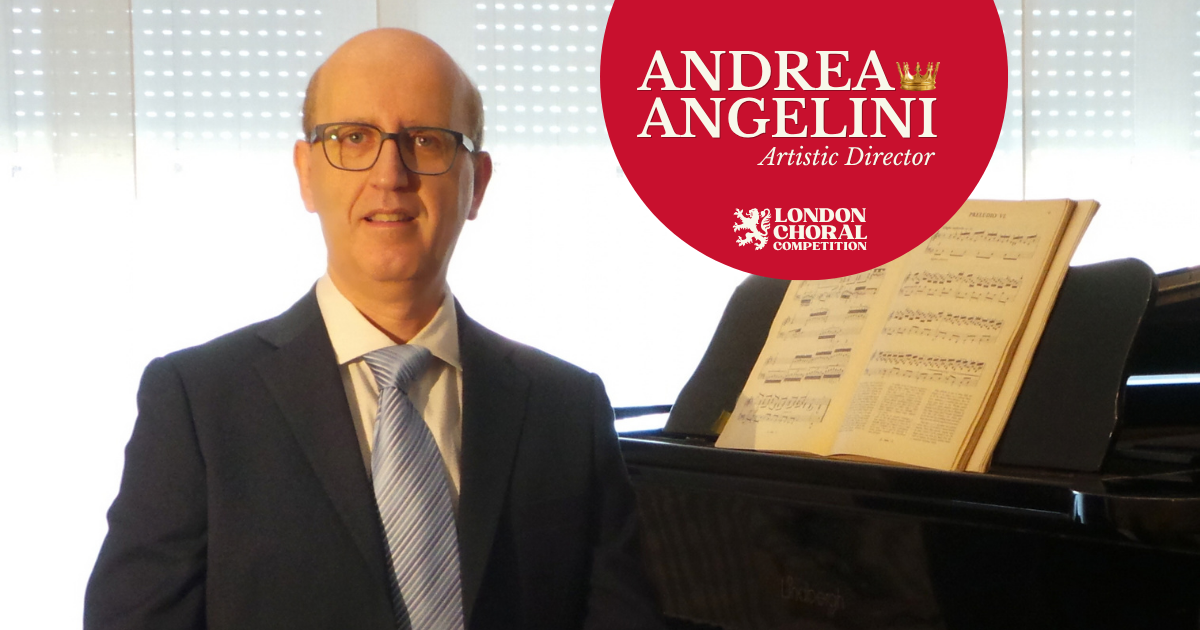
Prof. Andrea Angelini is the Artistic Director of the London Choral Competition 2027 – Sing for the Crown!, taking place in London from 14 to 17 July 2027.
An Italian conductor, composer, educator and international choral adjudicator, Angelini teaches Choral Conducting for Music Education at the Benedetto Marcello Conservatory in Venice, where his work focuses on the relationship between conducting, musical learning and ensemble leadership.
He is the founder of the professional ensemble Musica Ficta and Artistic Director of the Rimini International Choral Competition. From 2009 to 2020, he served as Editor-in-Chief of the International Choral Bulletin, a role that placed him at the centre of an international exchange of ideas about choral music, repertoire, conducting and performance.
Over the years, Angelini has conducted, taught and adjudicated in numerous countries, developing a perspective on choral music that combines practical musicianship, education and artistic judgement.
For Sing for the Crown! 2027, he is responsible for the competition's artistic direction and for bringing together an international jury representing different choral cultures and traditions.
What attracted you to the idea of a new international choral competition in London?
Andrea Angelini: London is one of the world's great cultural meeting points, and that makes it a particularly exciting place for choral music. Choirs are communities, but they are also expressions of particular languages, histories and musical traditions. Bringing ensembles from different countries together in London creates an opportunity not simply to compete, but to listen to one another and discover different ways of understanding choral sound.
For me, a successful competition should be more than a ranking. It should become a musical encounter.
As Artistic Director, what do you want the London Choral Competition to represent?
Andrea Angelini: I would like it to combine high artistic standards with openness and curiosity.
Competitions naturally involve evaluation, but the most interesting part is not deciding that one choir is “better” than another. It is understanding what each ensemble is trying to achieve and how convincingly it succeeds.
A Renaissance motet, a folk-song arrangement, a contemporary composition and a gospel performance cannot all be approached with exactly the same musical expectations. The jury must understand the language, style and intentions behind the performance.
That is why an international jury is so important.
How did you approach the selection of the jury?
Andrea Angelini: I wanted to bring together musicians with substantial conducting experience but also with different backgrounds and different ways of hearing a choir.
The announced panel includes Marcin Tomczak from Poland, Joy Hill from the United Kingdom, Vytautas Miškinis from Lithuania, Tommyanto Kandisaputra from Indonesia, Magdana Matitaishvili from Georgia and myself from Italy. One further member will complete the jury of seven.
This diversity is deliberate. Each juror brings a particular musical culture and professional experience. At the same time, we share a common responsibility: to listen carefully, fairly and constructively.
A good jury should never become seven people trying to hear exactly the same thing.
What do you personally listen for when a choir begins to sing?
Andrea Angelini: The first impression is important, of course, but then you begin to listen on several levels simultaneously.
The competition evaluates four principal areas: intonation, sound quality, fidelity to the score and artistic impression.
But these elements are deeply connected. Intonation is not simply a question of whether notes are correct. It depends on listening, balance, vowel formation, harmonic awareness and the relationship between voices.
The same applies to sound. There is no single “ideal” choral sound. The appropriate sound depends on the repertoire, language, style and expressive intention.
Ultimately, I am interested in whether the technical preparation serves a musical idea.
Does your work as a teacher influence the way you adjudicate?
Andrea Angelini: Very much. At the Benedetto Marcello Conservatory in Venice I teach Choral Conducting within the Department of Music Education, so I work constantly with the idea that conducting is not simply the act of controlling a performance.
A conductor creates the conditions in which singers can listen, understand, respond and gradually become more independent musicians.
This affects the way I hear choirs in competitions too. Behind every performance there is a rehearsal process. You can often hear whether singers understand what they are doing or whether they are simply following instructions.
For me, the most compelling ensembles are those in which responsibility for the music is somehow shared between conductor and singers.
You have spent many years working internationally. Has that changed your understanding of choral music?
Andrea Angelini: Absolutely. My years as Editor-in-Chief of the International Choral Bulletin, from 2009 to 2020, were particularly important in this respect. I was constantly encountering conductors, composers, researchers and traditions from different parts of the world.
International choral life teaches you very quickly that there is no single model of excellence.
Different cultures have different relationships with rhythm, language, vocal colour, movement, spirituality and performance. Travelling as a conductor and adjudicator has made me increasingly interested in those differences rather than trying to reduce them.
International competitions are particularly valuable when they allow those identities to remain visible.
What opportunities will choirs have in London in 2027?
Andrea Angelini: The competition welcomes ensembles in six categories, including secular and sacred choral music, folk, spiritual and gospel repertoire, children's choirs, senior choirs and non-competing festival participation.
So there is space for ensembles with very different identities and ambitions.
Choirs competing in Categories A, B, C, D and E that achieve at least 80.01 points and finish in first or second place will qualify for the Grand Prix.
The Grand Prix programme is deliberately concentrated: exactly two pieces, performed a cappella, with a total singing time of no more than seven minutes.
That creates a fascinating challenge. In seven minutes, a choir has to reveal its identity.
And what does winning the London Choral Crown mean?
Andrea Angelini: Of course, there is the competitive achievement itself, and the conductor of the winning choir will receive the London Choral Crown.
But I hope the real value goes beyond the trophy.
A choir preparing for an international competition works intensely on listening, repertoire, vocal technique, interpretation and collective responsibility. Then it encounters other ensembles that have gone through the same process in completely different ways.
That exchange can remain with singers and conductors long after the results have been announced.
Finally, what would you say to conductors considering bringing their choir to London?
Andrea Angelini: Come with the repertoire that best represents who you are.
A competition is not the place to imitate what you imagine a jury wants to hear. The most memorable performances usually happen when there is a clear connection between the music, the conductor and the identity of the ensemble.
London 2027 should be competitive, certainly – but also curious, generous and international.
That is the atmosphere I hope we can create.
Sing for the Crown! – London Choral Competition 2027 takes place from 14 to 17 July 2027, with events at the Royal College of Music and The Actors' Church in Covent Garden. Choirs can consult the official competition booklet for full information on categories, repertoire requirements, venues, jury members and application procedures.
Ready to sing for the Crown?
Places in each category are limited and applications are reviewed in the order they arrive. Start your choir's application for London 2027 today.